When it comes to toy making, the effectiveness of your painting process can greatly depend on the weather conditions. Many toy makers often seek clarity on how factors such as humidity, temperature, and sunlight can influence the application and durability of acrylic paints. Unfortunately, there isn’t a wealth of accessible, straightforward information on this topic. Many resources tend to provide vague advice like “don’t paint in the rain” or “avoid direct sunlight,” leaving toy makers with more questions than answers. Understanding the specific conditions under which acrylics perform best is essential for ensuring a successful and polished finish. This guide aims to provide valuable insights and practical tips based on advice from professionals in the industry, helping toy makers achieve the best results for their projects.
I did a lot of searching, trying to locate some definitive answers to painting with acrylics and weather conditions. I didn't find much. Most were along the lines of "don't paint in the rain" and "don't paint in the sunlight." I found some good info, mostly gleaned from forums where professional house painters hang out and from company websites.
Don't Paint when the dew point is within 5 degrees of air temperature. The paint will not cure properly, and the chance of running and sagging will be very high. Cure times will be lengthened.
I don't know how you are going to get the dew point without some instrument. I have a personal weather station from which I can get it.
Another way to look at this is to not paint when the humidity is high. It's an oversimplification, but it beats nothing. I have a previous post here somewhere about some paint that would not cure right. Humidity is probably what caused the problem. The paint finally did cure after it sat in the garage for a few weeks.
Don't paint in direct sunlight; it should be obvious if you know anything about sunlight and surface temperatures. At midday on a sunny summer day, I have seen the surface of the soil in my garden in excess of 140 degrees. Some surfaces have even higher temperatures. You can check this with one of those laser thermometers. The paint will cure too fast and will not flow out properly. Bonding and durability will also be affected. No shiny, smooth paint jobs for you.
Don't paint if the temperature is below 50 degrees F a durability and curing time issue. Paint that is applied at low temperatures does not bond as well. The colder it gets, the worse the problem is, and curing times are greatly increased.
Don't paint at temperatures higher than 90 degrees is pretty much the same thing as painting in direct sunlight but less severe. This is one of those unless you have to things. Some of us in the deep south are just going to have to do it, and I hope it works out OK.
Of course, this applies directly to acrylic paint, particularly house paint, but it is probably applicable as a rule of thumb for most paints.
There are also low humidity limits. However, since I live in Florida, I'm never going to have that problem. I have some experience with spraying lacquer in dry environments. I've seen days when the paint would dry so fast that all that hit the surface was sticky paint dust. It felt like sandpaper. It's not what you want on your custom hot rod or restored antique.
Understanding the impact of weather conditions on painting with acrylics is crucial for achieving optimal results. By considering factors such as dew point, humidity, temperature, and direct sunlight, painters can avoid common pitfalls that lead to poor adhesion and finish quality. While there are many nuances to navigate, adhering to these guidelines will help ensure a successful paint job. Whether you're a seasoned professional or a DIY enthusiast, taking the time to assess the environment before starting will save you from future frustrations and enhance the durability and appearance of your work.
2025-03-02
My Guidelines for Painting Wooden Toys with Acrylic Paint
2023-03-04
Painting Handmade Wood Toys: Tips and Considerations for Using Acrylic Paint
![]() |
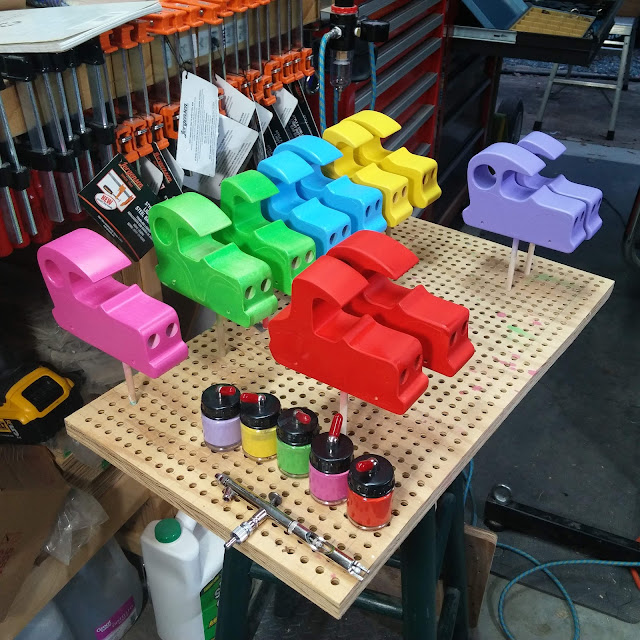
| Handmade Wood Toy Cars Hot Rod Freaky Fords Being Painted With Acrylic Baby Blue Paint |
Hot Rods
https://www.etsy.com/shop/odinstoyfactory?search_query=Hot+Rod
Toy Cars
https://www.etsy.com/shop/odinstoyfactory?section_id=34638962
Toy Trucks
https://www.etsy.com/shop/odinstoyfactory?section_id=34653279
Painting handmade wood toys can be a fun and creative way to add color and personality to your creations. While many types of paints exist, acrylic paints are often favored due to their versatility and ease of use. This blog post will discuss some tips and considerations when using acrylic paint to paint handmade wood toys, explicitly focusing on drying time vs. cure time.
First, let's briefly review the difference between drying and cure times. Drying time refers to the amount of time it takes for the solvent in the paint (in the case of acrylics, water) to evaporate, leaving behind a dry paint film. Curing and drying are usually measured in hours or days and vary depending on factors such as the thickness of the paint layer, the humidity and temperature of the environment, and the type of surface being painted on. Cure time, however, refers to the time it takes for the paint to harden and fully reach its maximum durability and adhesion. Depending on the same factors as drying time, this can take anywhere from a few days to a few weeks.
When painting handmade wood toys with acrylic paint, it is essential to keep both drying and cure time in mind. Here are some tips to help ensure a successful paint job:
- Prepare the surface: Before painting, ensure the wood surface is clean and free of dust or debris. Use sandpaper to smooth out any rough spots or splinters. Preparation is vital to a good finish.
- Use a primer: Primer and the decision to use it is generally optional and depends on the paint you are using. In some cases, applying a coat of primer can help the paint adhere better to the wood surface and prevent it from soaking into the grain. I usually want my paint to soak into the grain and rarely use primers.
- Thin coats: When applying the paint, use thin coats rather than thick ones. Thick coats can take longer to dry and cure and may also be more prone to cracking or peeling. If you need to apply a second coat, wait until the first coat is fully dry. Acrylics need to be bone dry before sanding, and you need to sand between each coat to get a smooth finish. Sanding between coats of paint is especially important if your final coat is a gloss finish.
- Allow for drying time: It is essential to allow each coat of paint to dry thoroughly before applying another coat or handling the toy. Drying can take anywhere from a few hours to a day or more, depending on the thickness of the coat and the humidity and temperature of the environment. I generally allow acrylic paints to dry overnight (12 or more hours) between coats. The paint needs to be bone dry before sanding. If the paint gums up your sandpaper it isn't dry enough.
- Allow for cure time: While the paint may feel dry to the touch after a few hours, it is essential to allow for sufficient cure time before handling the toy or exposing it to moisture. Curing can take several days to a few weeks, depending on the same factors as drying time. In my experience, flat paints dry and cure much faster than satin or gloss paint. I like to let my painted toys rest for several days.
- Consider a sealant: Once the paint is fully cured, you may want to apply a sealant to protect the paint and the wood surface. Again, make sure to choose a sealant suitable for wood and acrylic paint. Clear acrylics can be used for this purpose, and clear shellac will bond to just about any surface. This step is entirely unnecessary. I only apply a top coat to change the look of the toy. For example, you are applying a clear gloss acrylic to a toy painted with flat paint.
In summary, painting handmade wood toys with acrylic paint can be fun and rewarding, but it is essential to keep drying and cure time in mind. You can ensure a successful paint job by following these tips and allowing for sufficient drying and cure time.
#odinstoyfactory #handmade #woodtoys #madeinusa #madeinamerica
2021-07-13
Some Thoughts Airbrushes and Why I use Badger 155 Anthems When I Spray My Toys
![]() |
| Two of my Badger 155 Airbrushes |
Click on the photo to see some examples of my toys.
I am not an expert on airbrushes or how to use them. I paint toys with them, and that is it. This post is just a jumble of some things I learned about airbrushes the hard way.
I use airbrushes and spray acrylic paints, and shellac.
Acrylics are no big deal for cleaning up. I use generic window cleaner to clean my equipment. It cost about $1 for half a gallon the last time I bought some.
Shellac is more expensive to use, but the cleanup is simple, and if you don't get it all out, a bit of denatured alcohol will loosen it up. Shellac is very forgiving. Just don't spray it when the humidity is high. The alcohol will pull water out of the air.
It would be best if you strained your paint and shellac. I use the Harbor Freight paint filters and those disposable droppers to strain the paint. If you don't strain the paint, you will get clogs. Depending on the paint you use, you may need some additives to slow down the drying time.
You can spray shellac right out of the can. But you do need to strain it.
I own three Badger 155 Anthem Airbrushes and highly recommend them. Badger airbrushes will spray anything. Badger makes their airbrushes in the USA, and not only can you get parts for them, but Badger will rebuild them for shipping and the cost of the parts. My first airbrush was a Badger I had picked up at a yard sale for next to nothing. It sat on a shelf in my garage until I started messing with painted toys. I didn't know what I had, so I emailed Badger a photo, and they got right back to me with the model number and the parts I needed to buy and offered to do it for me. That's hard to beat support. The airbrush was more than 30 years old.
But what about those $9 Chinesium airbrushes?
I consider my Chinese airbrushes disposable. I use them when they will work for something I need and throw them away when they break.
I have several of these, and none have tip sizes big enough to spray acrylics other than the expensive made-for-airbrush brands. I can spray acrylic house paint through my Badge Anthem and use Behr Oops paint from Home Depot that costs me fifty cents for a sample can or $3-4 if I have it custom mixed. I also spray craft paint that I buy at WalMart. The Chinesium airbrushes will not spray acrylic house paint and do a poor job with the craft paint.
Sooner or later, you are going to need parts. You will break or bend the needle for sure, and a nozzle likely. At best, these parts are not readily available for the Chinese airbrushes. The first time I needed a nozzle and some needles for one of mine. It took weeks to find them and get them shipped here from Singapore. I did find a US seller that had a complete kit of all the parts, but it cost more than I paid for the airbrush. I can buy Badger parts on Amazon, Badger, or from many other sources.
You can spray lacquer through a Badger airbrush. It's a crapshoot to do lacquer thinner through one of the Chinese airbrushes. The solvent will dissolve the seals in some of them. I have cleaned out one of my Badger airbrushes with acetone without harming them.
I went through a lot of pain to figure all of this out. I have a drawer full of airbrushes. There is a lot of info out there, but 99% of it is for artists. I had to fit this all together with bits and pieces I gleaned here and there. The turning point came when someone gave me a Badger 155 Anthem. The first time I used it, I knew this was what I had been looking for all along.
I use my shop air compressor with a filter and regulator just for the airbrush. I also have a cheap Harbor Freight compressor for airbrushes. It works just as well, but it runs all the time.
2018-12-04
What kind of paint are you using for your Bad Bob's Custom Motors cars?
![]() |
| Bad Bob's Custom Motors |
I use a variety of paints from various sources. I like the acrylic house paints the best. All of the paints are nontoxic when cured.
I like to use a white primer to seal the wood and make the colors pop. In this case, I am using Zinsser B-I-N shellac based primer.
I prefer to use an airbrush for painting toys but, I have to paint outdoors, and the weather where I live does not cooperate, and I have to wait or use a brush. I used an airbrush for these wooden toy cars. My airbrush is a Badger Anthem 155.
I prefer acrylics over all other paints. They clean up easily, cover well, and are readily available in a vast array of colors. To clean, I flood with water to get rid of the bulk of the paint. The remaining paint is easily removed with ammonia-based cleaners such as window cleaner. I use household$ ammonia to remove dried paint.
I used the following to paint these wooden toy car bodies.
Pink - Behr Acrylic House Paint
Green - Apple Barrel Gloss Green Acrylic Craft Paint
Blue - Behr Acrylic House Paint - Oops Paint
Yellow - Createx - Airbrush Paint
Red - Apple Barrel Bright Fed Acrylic Craft Paint
Lavender - Behr Acrylic House Paint - Oops Paint
Primer - Zinsser B-I-N
![]() |
![]() |
![]() |
![]() |
![]() |
![]() |
![]() |
![]() | |
2018-10-28
Do you use acrylic primer?
![]() |
| Brush Painted Wooden Toy Car - Hot Rod Freaky Ford - 32 Deuce Coupe - MDF - Blue - Black - Gold |
I tried an acrylic primer once. It was such a pain to sand that I never did it again. I've tried all sorts of methods for painting wood and MDF including using automotive primer filler I had left over. As far as I can tell it doesn't make any difference. If I want to seal the material, I use shellac for the base coat. If I'm using a color that doesn't cover well I use white for the first coat or two.
No matter what finish I use, I apply at least two layers of finish sanding between each layer. The first seals and makes the fuzzies stiff so the sandpaper can smooth the surface. If I get an acceptable finish, I stop at the second coat. If not, I continue to paint and sand until I am satisfied with the result.
I have tried just about every method I can find for applying finishes to my toys. The best I have used so far is spraying with an airbrush. I don't have a spray booth and need to spray outdoors. Painting outdoors is very dependent on weather conditions. Therefore, I use a brush to paint most of my toys. This one is brush painted with Behr acrylic house paint. Oops paint I purchased from Home Depot for $0.50 with no primer coat.
![]() |
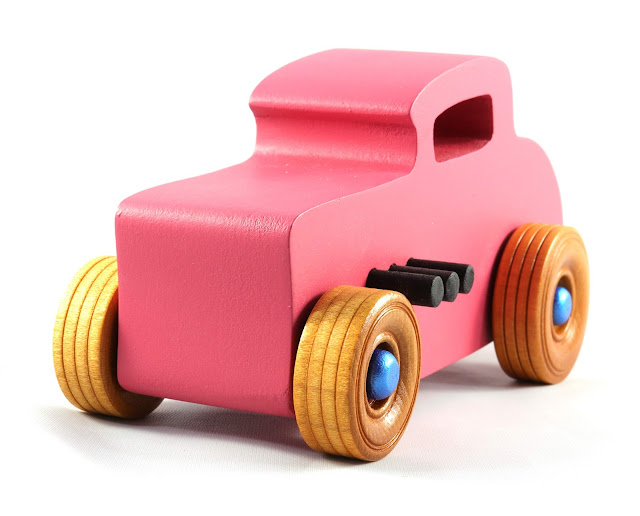
| Painted With An Ait Brush - 20181003-202131 482476086 Wooden Toy Car Hot Rod Deuce Coupe From the Hot Rod Freaky Ford Series Pink |
2018-05-06
Which Finish Should I Use On My Toys?
It's not a simple choice when you intend to sell them or even give them away. You have to consider the age of the person the toy is designed for. There are several finishes to choose from when finishing wooden toys.
- Drying Oils
- Non-Drying Oils
- Polyurethane
- Shellac
- Paint
If I am making a toy intended for a child under three years old that puts everything in their mouth and likes to chew on things No finish at all is probably the best choice. These toys should be very simple and made from woods like hard maple. Although ti its used by many toymakers, I would not put any sort of oil on these toys.
In my totally unscientific testing, I find that kids will almost always go for the painted toys. I have seen a few exceptions to this, but not many. Where the kids get to look at the toys, the painted toys may rule the day. If selling online adults are usually the shoppers. They seem to like to see the wood grain, but not always. I have had customers tell me that they prefer the rustic look. Then there is what colors to use. If you want to sell your toys, you have to pick colors that someone you do not know will like.
For kids three years old and up, my target market. My rule is anything but non-drying oil finishes is good. All of the finishes are nontoxic when cured.
In my online store and in social media that gets the most views is a pine bodied hot rod finished with shellac. It is rapidly overtaken by a pinewood car finished with polyurethane. Being sure what drives these things is very difficult. In this case, I think that the photography may have something to do with it. The difference is quite significant. Within the first week, it passed the longstanding top listing that had been there for more than a year.
![]() | ||
| 32 Ford Sedan Hot Rod finished with amber shellac, and a bit of acrylic paint is the current leader for the last 12 months in my Etsy shop. |
| A Hot Rod 27 T-Coupe is the up and coming challenger poised to overtake the leader after only a short time. |
My top five listings are a mix of polyurethane, shellac, paint and unfinished toys. I know this is not really a scientific method, but I work with the data that I have. Recently I posted a link to a painted car I was making on my Pinterest board. After the posting, my Pinterest views went up by more than 300k. I have a suspicion that this one will upset the apple cart. How did I pick the colors? I didn't, my grandson picked colors that I never would have chosen.
| Wooden Toy Car - Bad Bob Motors Coupe - Amber Shellac - Green - Yellow |
Confused yet. I am.
My current take on all of this is that it depends. I work a lot with pine. If the grain looks nice, I will use polyurethane. Otherwise, it will get paint or shellac. When I make custom orders, I make extras. Just in case one is damaged or broken I have more than one and I don't need to start over. Sometimes one of these will have some beautiful grain. I will save that one to finish with polyurethane. Playsets pretty much demand paint. Toys made from MDF always get painted. I never apply any of the wood blocks I make and would not use any kind of finish on blocks.
Finishing toys are difficult. You may find that finishing is the most time consuming and difficult part of making toys. It's a complicated issue. I have only touched the surface of. I have more posts planned to discuss it.
-
Harbor Freight Four Inch Ratcheting Bar Clamp/Spreader I use a lot of clamps. They are the first clamps of this type sold by Harbor Freigh...
-
Shop Odin's Toy Factory Shop Etsy As the holiday season approaches, it's the perfect time to start thinking about how to adorn your ...
-
Order Today Puzzle Pal s Hot Rods Minivans There’s something truly special about handmade toys—they’re crafted with care, designed to insp...