Blog Archive

Showing posts with label Wheels. Show all posts

2025-02-15

20240616-161533 Toymakers Shop - Tow Truck - Wheels - Purple - Amber Shellac: The Perfect Finish for Toy Wheels


Wooden Toy Wheels Finished With Amber Shellac Drying On A Shop Made Peg Board
 

My Five Truck Fleet

When finishing toy wheels, I use Amber Shellac. It provides a beautiful, warm appearance and has practical benefits that make it ideal for kids' toys.

One of the main reasons I favor shellac is that it doesn't mar the surfaces where the wheels roll. Unlike flat black paint, which can sometimes rub off and leave those pesky black marks behind, shellac stays put.

The wheels I work with are typically made from end grain, which tends to soak up a considerable amount of shellac. There have been times when the shellac has soaked through the wheel.

Shellac sprays beautifully straight from the can, but I prefer to apply it with a brush on the wheels. This method is less messy and gives me more control over the application. One common issue with dipping and spraying is that shellac can inadvertently get into the center holes of the wheels. Shellac inside the axle hole is crucial, as it can lead to glue failure when it comes time to attach the wheels to wooden axles.

In conclusion, amber shellac is a fantastic choice for finishing toy wheels. Its aesthetic appeal, safety, and ease of use make it an excellent option for any toy maker.

2023-05-02

My Prefered Method of Making Wooden Toy Wheels Is to Cut them With a Scroll Saw and Sand them Round with a Belt Sander

A Large number of small hanmade wooden wheels.
A few of the woodem sheels I have made.
 

f you love toys, then you've likely encountered the need to make wheels at some point. Fortunately, there are many methods you can use to make wheels, and in this post, I will discuss my favorite method of making wheels.

My preferred method of making wheels involves drilling the center holes first, cutting the wheels out with a scroll saw, and sanding them using a belt sander and a jig to sand the wheels perfectly round. The jig, a dowel in a piece of wood clamped at an appropriate distance from the sanding belt, makes the process fast and easy. The result is a hundred perfectly round and sanded smooth wheels.

One of the most significant advantages of this method is its simplicity. The jig is so straightforward that I don't bother keeping them. This simplicity makes it easy to make wheels of any size.

My method is an excellent option if you need a quick and efficient way to make many perfectly round and smooth wheels. It's particularly suitable for mass-producing toys.

To summarize, if you enjoy making toys, you must know how to make wheels. You can quickly and efficiently produce many wheels using a scroll saw, a belt sander, and a jig. Although it may not be appropriate for every circumstance, it's worth considering if you need to make a lot of wheels in a short time.

 #odinstoyfactory #handmade #woodtoys #madeinusa #madeinamerica

2020-04-28

Toy Makers Shop - How To Get The Wooden Wheels On Your Toys To Roll Well

Wooden Toy Wheels Nylon Washers and Axle Pegs Ready For Assembly
I have don't some extensive testing with my grandson building cars with many methods of mounting wheels to see which ones worked best and if they didn't work well why. Using the techniques outlined below, I have built Play Pals that can compete with Hot Wheels cars on a Blue Track.

Washers behind the wheels are essential. They act as a spacer between the wheels and the body. Without the washers, the wheels will rub against the body. Friction between the wheel and the body of the toy will slow the toy down and eventually damage the finish.

Nylon Washers In A Storage Bin Used For Bearings and Spacers Behind Toy Wheels

I use nylon washers behind the wheels on all my rolling toys. I tested several washer materials, and nylon is substantially better than any of the metal washers. The nylon acts as a crude bearing with the added benefit that wood glue will not stick to it. If you get a little to much glue that squeezes out on the back of the wheel, it will not glue the wheel to the car.

Wooden Toy Wheel Nylon Washer and Axle Pegs Ready For Dry Fit


Drilling your axle holes square and true is very important.  If the axle holes are not parallel to each other they work against each other. Axel holes also need to be drilled at 90 degrees to the surface. A drill press is a great help getting the holes straight. Your stock needs to be flat. Construction (cheap/free) lumber is prone to cupping, bowing, and cupping. Drilling the hole straight and true is difficult if the wood isn't flat.


Handmade Wooden Toy Bat Car Example of a Toy Car With Axle Pegs

Axel pegs work better than solid axels that go all the way through the body. They work better because of the wheels operating independently of each other. They also tend to roll straighter.

Wheels on your toys should be mounted as close to the body as possible being sure to leave a small gap. You can ensure the gap by making a jig from a thin plastic card that is notched to fit around the axels.

Wooden Toy Wheels Waiting For Glue To Cure In A Shop Made Jig


Glue the wheels on one end of the axel first and let the glue cure enough to hold the wheels tight. No more than twenty minutes, but it depends on the working time of your glue. When the first set of wheels is ready to assemble everything, wheels, axles, washers, and spacers, press everything up snug and pull out the spacers. It is essential that everything fits closely else the wheels will wobble and slow down the toys.

Wooden Wheel Axle Peg and Nylon Washer Ready For Gluing


Dry fit your wheels and axels. When you have glue on your parts is not the time to find out that the dowel does not fit the hole in your wheels.

Using a bit of wax on the axles helps but not as much I initially expected. It is somewhat challenging to wax the axels without getting the was somewhere you don't want it. Wax prevents wood glue from bonding.

You can use polished nails for axles and get toys to roll even faster. Plastic wheels roll better than wood. However, I don't use plastic wheels or nails. I prefer to stay as close to 100% wood as I can.

Summary:
If you want your toys to roll well, washers between the wheels and the body are a must.

Nylon washers work better than any metal.

Drilling everything straight, accurate, and square to the sides is essential to keep the wheels running true.

Axel holes must be parallel to each other. The more axels the toy has, the more critical this gets.

Axel pegs work better than solid axels, and you can pin them to keep them from coming out.

Wheels should be mounted as close to the body as possible without touching. Use a jig made from a thin plastic card to keep the space.

Glue the wheels one side at a time, making sure they are square to the axels. Let the first wheels cure before adding the second set of wheels.

A bit of wax on the axels helps, but be sure to keep it off the places where you need glue.

2020-04-02

More Dicusion On Mounting Wooden Toy Wheels


Toymakers Shop Handmade Wooden Toys Play Pal Wheels Axels On Waiting For The Glue To Set
Play Pal Wheels Axels On Waiting For The Glue To Set

When I mount wheels on one of my toys that use dowels for axels, I like for the end of the axel to look like a little hub cap. The look I am going for is similar to the baby moon hub cap, although smaller in scale.

To achieve the baby moon look. I carefully measure the axels to be slightly longer (about 1/16-inch) than required and round the ends by hand using sandpaper. The ends of the axels are dipped in metallic paint and allowed to cure at least overnight.

For these to look right, the ends of the axels need to line up flush with the wheel with only the rounded part protruding.  The best way I have found to do this is to glue on one wheel at a time and allow the glue to set.  Positioning the wheel is pretty easy if the wheel isn't too tight, and the glue you are using has a long enough working time to make needed adjustments. If the fit is tight, I use a vise with jaws padded with leather to press the wheel on to the axel. The soft leather lets the axel protrude almost the perfect amount. I wipe glue squeeze out with a damp blue paper towel. The water doesn't cause a problem since I finished the wheels and axel end.

It is essential to let the glue cure enough to lock the wheel in place before attempting to mount the other wheel. In the photo is a batch of wheels waiting for the glue to set. If you have a sizeable enough quantity of wheels, you may be able to work continuously.

2017-12-16

Some Thoughts on Wooden Wheels


The following are some thoughts that came to mind while watching the video included at the end of this post.  I've made hundreds maybe thousands of wheels using the hole saw method. It works, and it can work well, but as with anything, there are pluses and minuses.


I would never use vegetable oil to finish anything. Vegetable oil can and will eventually go rancid and can mold. If you want to use an oil and beeswax finish, use mineral oil. Mineral oil will not spoil.


Wheels should have spacers between the wheel and the body. I use nylon washers, but metal washers will work. If you do not use spacers, the wheels will rub against the body. Not only will this remove the finish and eventually wear into the wood but the additional friction increases the rolling resistance. Sometimes to the point where the wheels slide instead of turning.


Always dry fit you axle pegs with the wheels if they are too tight or too long and you don't know this before you add glue, you could ruin the toy. Once you start inserting the peg with glue on it, there is very little chance of getting it back out without damaging something. I've had to cut wheels off, drill out the dowel, plug the hole and drill a new axle hole. That is where I learned about how important it is to dry fit.

Remember that wood expands and contracts with changes in humidity. Your holes might be slightly larger or smaller than when you drilled them two weeks ago.


1/4 inch dowels may not fit in 1/4 inch holes. They probably will not fit.


Round dowels are not round. When measuring dowels with your calipers, measure in several locations. You will probably discover that your 1/4 inch dowel is only approximately 1/4 inch.


Wood glue causes the wood to expand slightly. If it is a tight fit and you have to force it in dry its going to be even tighter when glue is applied.


If the excess glue has no place to go, it can split the wood or come out someplace you did not expect. I have used hammers and various clamps and vices to force and axle peg into place. It doesn't always work

If the parts fit as they should, you don't need much glue. I always get too much.


I don't like driving pegs in with a mallet or hammer. You have more control using a clamp or vice padded of course. Less chance of breaking something too.


When sanding the wheels on a drill press be sure to sand lightly on the edges or your wheels will be out of round as the sandpaper will cut slower on the end grain. Use a jig and a sanding belt or disk to get near perfect wheels.


Flat sawn wheels may not stay round and might warp, cup, or twist. Wood does not expand the same amount across the grain as it does with the grain. It is good to let the wheels sit for a while before using them. They are usually OK but, It would not be good to have a wheel shaped like a potato chip after it sits around for a few days.


So my wheels would all be the same size and at least start round I always used a jig with a stop to sand the edges of the wheels. Using this method I can make a hundred wheels and have them all come out the same size. Using a jig like this and a belt sander with 60 grit sandpaper you can drill a hole in a piece of wood, mount it on the jig and sand it round. If you do this indoors, you better have an outstanding dust collection.

Wooden Toy Wheels for Model A Norm Marshal

Wooden Toy Wheels Steering Wheels for a Norm Marshal Model A Toy Car

2017-12-03

Toy Makers Shop - Wheels, Wheels, and More Wheels

If you are going to make toys you are going to use a lot of wheels. The last time I bought wheels I ordered about 1600  wooden wheels. Sounds like a lot but keep in mind that one of my little tractor trailer rigs has 18 wheels. 500 hundred wheels make 27 trucks with a few extras.

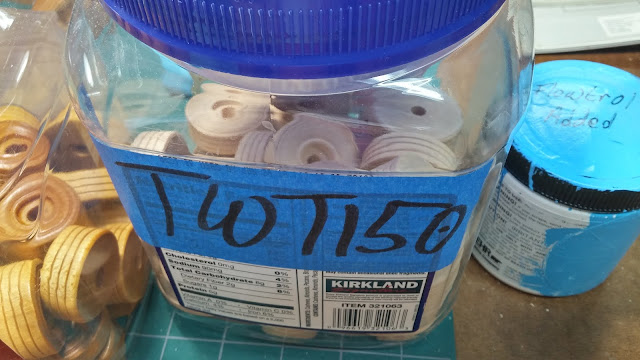
After that last order I've taken to storing wheels in the large jars that nuts and other things come in.  I did this after I received an order of a 1000 wheels that all came in one big bag. Previous to this they were all in bags of 100. Once you open the bag you have to do something with the wheels.  The jars are cheap as in practically free.  They are quite sturdy and sit nicely on a shelf.

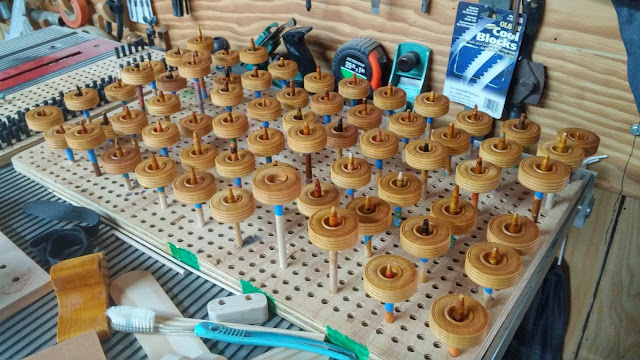
Using the set up pictured below I can finish wheels continuously provided the weather cooperates. If the relative humidity is below 50% shellac drys very fast. The first wheel in the rack will be dry long before I drop one into the last hole.

Wooden Toy Car Wheels TWT150 On the Drying Rack
20171201_122332_HDR Wooden Toy Car Wheels TWT150 On the Drying Rack

Wooden Toy Car Wheels TWT150 Shellaced and in the Jar
Wooden Toy Car Wheels TWT125 Shellaced and in the Jar
Wooden Toy Car Wheels TWT150 Unfinished